

How to Stop Puppy Eating Fast: 7 Vet-Safe Fixes
Table of Contents
- Why Is My Puppy Eating So Fast? (And When It's a Problem)
- The Real Dangers of Bloat in Dogs (GDV Explained)
- Step 1: Switch to the Best Slow Feeder Bowls for Puppies
- Step 2: Use Puppy Enrichment Feeding Games for Every Meal
- Step 3: Split Meals and Set a Calm Feeding Schedule
- Step 4: Separate Multi-Pet Households to Stop Gulping
- Step 5: Hand-Feeding and the Muffin Tin Method
- Common Mistakes to Avoid When Slowing Down Mealtime
- Frequently Asked Questions
Last Updated: September 7, 2026
Why Is My Puppy Eating So Fast? (And When It's a Problem)
Many new puppy owners watch in disbelief as their pup inhales a full bowl of kibble in under thirty seconds. Puppy eating fast is often a leftover survival instinct from the litter, where the fastest eater got the most food.
Rapid eating leads to aerophagia, or swallowing air, which causes digestive distress, vomiting, and regurgitation. More seriously, gulping food is a known contributor to bloat, a life-threatening condition we will break down next (acvs.org). Rapid eating leads to aerophagia, or swallowing air, which causes digestive distress, vomiting, and regurgitation. More seriously, gulping food is a known contributor to bloat, a life-threatening condition we will break down next.
The good news is that this behavior is highly fixable. With consistent effort and the right tools, this behavior is highly fixable.
The Real Dangers of Bloat in Dogs (GDV Explained)
Bloat, clinically known as gastric dilatation-volvulus (GDV), is one of the most serious medical emergencies a dog can face. The condition occurs when the stomach fills with gas and then twists on itself, trapping blood flow and requiring immediate veterinary intervention.
The link between eating speed and GDV is well documented in veterinary medicine. When a puppy gulps food, they swallow large volumes of air alongside the kibble. This air stretches the stomach, and in deep-chested breeds, that stretching can lead to a dangerous rotation. According to veterinary guidance on gastric dilatation-volvulus risk factors, large and giant breed dogs with deep chests face the highest risk, but the habit of rapid eating raises the danger for any dog.
Slowing down mealtime is a preventative measure that directly reduces the volume of air swallowed. This is why addressing puppy eating fast is about more than saving your floors from scattered kibble. It is a genuine health intervention.
Step 1: Switch to the Best Slow Feeder Bowls for Puppies
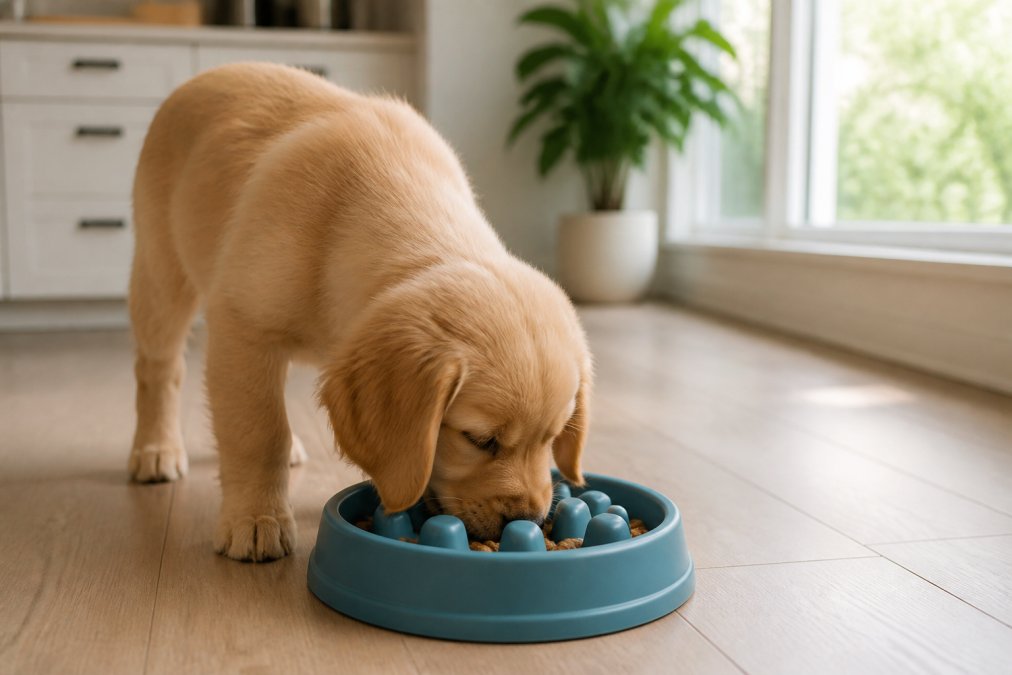
The fastest fix for rapid eating is changing the delivery system. The best slow feeder bowls for puppies use raised ridges, mazes, or textured patterns that force the dog to work around obstacles to reach each piece of kibble, extending mealtime from seconds to several minutes.
When selecting a bowl, look for food-grade materials that are dishwasher safe and sturdy enough that your puppy cannot tip them over. For puppies, start with a shallow maze pattern and upgrade as their problem-solving skills grow.
Choosing a Bowl by Breed Shape and Size
Most guides treat all puppies the same, but breed conformation should drive your bowl choice. A brachycephalic puppy (Bulldog, Pug, French Bulldog) has a flat face and shortened muzzle, making deep maze bowls frustrating and potentially painful as they scrape their noses against the ridges. For these breeds, choose a very shallow, wide bowl with gentle, rounded bumps rather than sharp vertical prongs.
Deep-chested breeds (Great Dane, German Shepherd, Doberman, Standard Poodle) face the highest risk of GDV, so the primary goal is slowing intake AND reducing air swallowing. For these puppies, a bowl with a central dome or a spiral pattern forces them to eat from the outer edge inward, which naturally reduces the angle at which they gulp. Avoid bowls with very high sides for these breeds, as they encourage a head-down, gulping posture.
Small breeds and toy breeds (Chihuahua, Maltese, Yorkie) often have smaller mouths and less jaw strength. A maze with tight corners may frustrate them to the point of giving up. Look for bowls with wider channels and softer silicone textures that yield slightly under pressure.
Material Matters: Silicone vs. Ceramic vs. Stainless Steel
The material affects both safety and effectiveness. Food-grade silicone bowls are lightweight, non-slip, and gentle on a puppy's developing teeth, but they can be chewed by aggressive eaters. Ceramic bowls are heavier and harder to tip, but must be checked for lead-free glaze. Stainless steel is the most durable and easiest to sanitize, but it can be noisy as kibble rattles against the metal, which may startle anxious eaters.
The Sizing Progression
A slow feeder is not a one-time purchase. As your puppy grows, their jaw width and tongue reach change. A bowl that was challenging at 8 weeks may become trivial at 5 months. Plan to reassess every 4-6 weeks. If your puppy finishes a meal in under 90 seconds with the slow feeder, it is time to increase the difficulty level, not just the bowl size.
Step 2: Use Puppy Enrichment Feeding Games for Every Meal
Puppy enrichment feeding games turn a rushed meal into a mentally engaging activity that satisfies your dog's natural foraging instincts. Instead of dumping kibble in a bowl, hide portions in puzzle toys, snuffle mats, or rolling dispensers that release food gradually.
This approach works on two levels. Physically, it forces slower, more deliberate eating. Mentally, it provides enrichment that reduces boredom and anxiety, which are common drivers of food obsession. The UC Davis School of Veterinary Medicine guide on canine enrichment notes that food-based enrichment activities are among the most effective ways to improve behavioral welfare in dogs.
The Interactive Treat Puzzle Toy challenges your puppy to slide pieces and discover hidden treats, while the Roll & Reward Interactive Feeder Toy wobbles and rolls to encourage active foraging. Both add mental stimulation to every meal.


| Feeding Method | How It Works | Best For | Time to Finish Meal |
|---|---|---|---|
| Standard Bowl | Free access to kibble | No issues | Under 30 seconds |
| Slow Feeder Bowl | Ridges and mazes slow access | Mild gulping | 2-5 minutes |
| Puzzle Feeder | Moving parts require problem-solving | Moderate gulping + boredom | 5-10 minutes |
| Snuffle Mat | Kibble hidden in fabric | Anxious or high-drive eaters | 8-15 minutes |
Step 3: Split Meals and Set a Calm Feeding Schedule
Portion control is not just about how much you feed, but how you distribute it. Instead of one large morning bowl, split your puppy's daily ration into three or four smaller meals spaced evenly across the day. This keeps blood sugar stable, supports digestive health, and reduces the frantic hunger that drives fast eating.
A calm feeding schedule also involves routine. Serve meals at the same times daily in the same quiet location. Remove the bowl after 15 to 20 minutes regardless of whether it is empty. This teaches your puppy that food is not scarce, which gradually reduces the urgency behind the gulping.
Step 4: Separate Multi-Pet Households to Stop Gulping
If you have more than one dog, competition is likely the root cause of the rapid eating. Resource guarding, even in mild forms, drives dogs to eat as quickly as possible so no other animal can steal their meal.
Feed dogs in separate rooms or use baby gates to create visual barriers during mealtime. Each dog should have their own quiet space where they feel secure. This separation should continue until every dog has finished eating and left their bowl.
For multi-pet homes, a SmartFeed Wi-Fi Automatic Pet Feeder can help by dispensing small portions on a timer, reducing the sense of competition over a single bowl. The schedule is app-controlled, so you can ensure each pet eats on their own timeline.

Step 5: Hand-Feeding and the Muffin Tin Method
Hand-feeding is the most direct behavioral modification technique for puppy eating fast. By offering one piece of kibble at a time, you control the pace completely and build a stronger bond through positive interaction.
For a more independent approach, the muffin tin method is a proven favorite. Place a few pieces of kibble in each cup of a standard muffin tin. Your puppy must move from cup to cup, which naturally slows the pace. Increase difficulty by placing tennis balls over some cups, forcing your puppy to figure out how to remove them.
The Behavioral Layer: Why Some Puppies Gulp Beyond Hunger
Mechanical slowing devices address the speed, but not the driver behind it. A significant subset of puppies eat fast not because they are hungry, but because they are anxious. This pattern often traces back to resource guarding in the litter, where the puppy had to compete for access to the mother or a shared food bowl.
How can you tell if your puppy is an anxiety-based eater rather than a simply enthusiastic one? Watch the body language. An anxious eater often:
- Eats with a stiff, tense body posture
- Glances around the room while chewing
- Growls or stiffens if you approach the bowl mid-meal
- Eats fast even when fed alone in a quiet room
- Shows signs of relief (not satisfaction) when the bowl is empty
For these puppies, hand-feeding is not just a pace-controller; it is a trust-building exercise. Each piece of kibble offered from your hand teaches the puppy that food comes from a safe, predictable source. Start by sitting on the floor at the puppy's level. Offer one piece at a time, saying the puppy's name before each piece. If the puppy shows signs of tension, pause and wait for a relaxed posture before continuing.
The "Trade-Up" Protocol for Resource Guarders
For puppies that show guarding tendencies during hand-feeding, use a structured trade-up protocol. Offer a low-value piece of kibble. While the puppy is chewing, drop a higher-value treat (a small piece of chicken or cheese) near the bowl. This teaches the puppy that human approach equals good things, not food removal. Over several sessions, gradually move your hand closer to the bowl while the puppy eats, always pairing your approach with a treat drop.
The Muffin Tin as an Anxiety Tool
The muffin tin method works for anxious eaters because it breaks the meal into small, discrete challenges. Each cup is a mini-goal that requires the puppy to move, sniff, and problem-solve, interrupting the frantic focus on the bowl. For highly anxious puppies, start with only 3-4 cups filled and the rest empty, then gradually increase the number of filled cups.
A variation that adds a calming element: scatter a few pieces of kibble on a snuffle mat first, then place the remaining portion in the muffin tin. The initial sniffing and foraging behavior has a calming effect on dogs, lowering cortisol levels before the more structured part of the meal begins.
When Hand-Feeding Is Not Appropriate
Hand-feeding is not ideal for every situation. If you have multiple puppies or a busy household schedule, hand-feeding every meal may be impractical. It is also not recommended for puppies that are extremely mouthy or that become over-aroused by the close interaction. In these cases, use hand-feeding for only 10-15 pieces of kibble as a training warm-up, then transition to a slow feeder bowl.
Common Mistakes to Avoid When Slowing Down Mealtime
The first mistake is raising the bowl off the floor. Elevated feeders are sometimes recommended for large breeds, but for a puppy that gulps, a raised bowl can actually increase the speed of intake and the volume of air swallowed. Keep the bowl on the floor until eating habits are corrected.
The second mistake is free-feeding, or leaving a bowl of kibble out all day. This eliminates the structured mealtime that teaches portion control and can lead to obesity.
A third error is giving up too soon. Behavioral modification requires consistency over days, not hours. If you switch back to a normal bowl after three days because the puppy seems slower, you risk undoing all progress. Stick with the slow-feeding method for at least two full weeks before assessing results.
Frequently Asked Questions
Why does my puppy eat so quickly?
Puppies often eat fast due to instinct, competition from littermates, or simply high food motivation. In multi-dog homes, this behavior can be a form of resource guarding. While common, rapid eating leads to gulping air (aerophagia), which can cause vomiting and digestive distress. It also raises the risk of choking. If your puppy consistently inhales meals in under a minute, it's worth addressing with slow-feeder bowls or enrichment games to protect their long-term digestive health.
Can fast eating cause bloat in puppies?
Yes, fast eating is a known risk factor for bloat (gastric dilatation-volvulus, or GDV). While more common in large, deep-chested breeds, any dog that eats too fast swallows excess air. This air can cause the stomach to dilate, and in severe cases, twist. Bloat is a life-threatening emergency. Using a slow-feeder bowl and splitting meals into smaller, more frequent portions are preventative measures that reduce air intake and help protect your puppy from this dangerous condition.
What are the best slow feeder bowls for puppies?
The best slow feeder bowls for puppies have raised ridges, mazes, or textured patterns that force your pup to work around obstacles to reach the kibble. Look for food-grade, non-slip materials that are dishwasher-safe for easy cleaning. Avoid bowls with very deep grooves that are hard to lick clean. For a durable option, consider an interactive puzzle toy that dispenses treats as it rolls, which slows eating while adding mental enrichment to your puppy's mealtime routine.
How do I transition my puppy to a slow feeder?
Don't switch cold turkey. Start by placing a small portion of your puppy's regular kibble on top of the slow-feeder bowl's ridges so they can still smell and reach it easily. This prevents frustration on the first try. For the first few meals, you can also mix in a high-value treat to build a positive association. Gradually fill the bowl more completely over several days until your puppy is comfortable working for their entire meal.
Slowing down a rapid eater takes patience, but the payoff is a healthier digestive system and a calmer dog. Start with a slow-feeder bowl or puzzle toy, split the meals, and remove competition from the equation. The Pet Grove offers a curated selection of enrichment feeders designed to make every meal a healthy, engaging experience for your puppy.


