

Best Puzzle Feeders for Puppies: 2026 Guide
Table of Contents
- Quick Comparison Table
- Benefits of Interactive Dog Feeders for Puppy Development
- How to Introduce Puzzle Toys to Puppies Safely
- Best Slow Feeder Bowls for Puppies and Puzzle Alternatives
- Top Puzzle Feeders for Puppies: Detailed Reviews
- How to Choose the Right Puzzle Feeder for Your Puppy
- Cleaning, Safety, and Maintenance for Long-Term Use
- Conclusion
Last Updated: August 22, 2026
Quick Comparison Table
| Puzzle Feeder | Best For | Price | Key Feature |
|---|---|---|---|
| Interactive Treat Puzzle Toy | Problem-solving development | $10.39 | Movable pieces encourage cognitive engagement |
| Roll & Reward Interactive Feeder Toy | Active play and foraging | $15.90 | Wobbling design dispenses treats during movement |
| Planet Treat Ball | Bouncy enrichment play | $13.41 | Unpredictable movement keeps puppies engaged |
Benefits of Interactive Dog Feeders for Puppy Development
Puzzle feeders reshape how puppies think about food and play. When a puppy works to extract treats, their brain activates in ways a regular bowl cannot, strengthening neural pathways and building problem-solving skills during a critical developmental window between 8 weeks and 6 months (peer-reviewed research).

Interactive feeders slow eating, supporting digestive health by preventing gulping and bloating (aaha.org). They also tackle behavioral issues before they start, a puppy occupied with problem-solving is less likely to develop destructive chewing or separation anxiety. The foraging behavior mirrors natural canine instincts, satisfying deep psychological needs. When puppies successfully extract treats, they experience genuine accomplishment, building confidence and creating a healthier relationship with feeding time.
How to Introduce Puzzle Toys to Puppies Safely
Start with empty or lightly-filled puzzle feeders during play sessions, never during primary meals. Let your puppy explore without pressure, then add a single treat in an obvious location. Reward attempts with praise and encouragement.
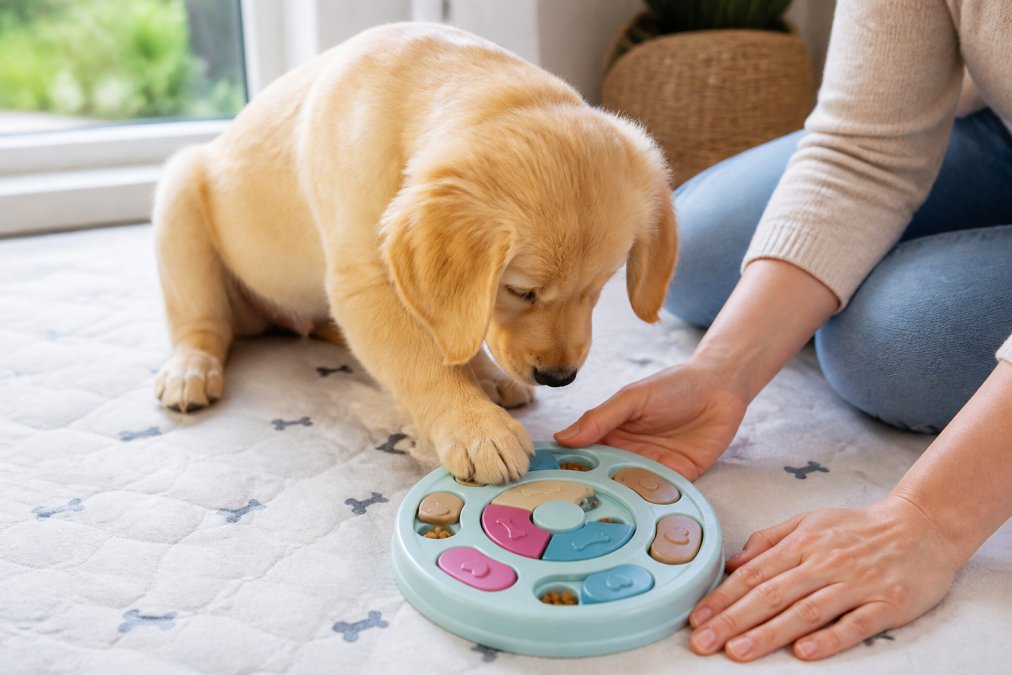
Supervision is essential. Watch for frustration, excessive chewing on the toy itself, or abandonment. The Interactive Treat Puzzle Toy works well for this stage because its movable pieces respond to light pressure, giving puppies quick feedback.
Limit initial sessions to 5-10 minutes. Puppies tire quickly, and stopping while engaged creates anticipation for the next session. Never leave puzzle feeders unsupervised with puppies under 6 months. Remove the toy if your puppy chews the toy itself rather than manipulating it to access treats.
Best Slow Feeder Bowls for Puppies and Puzzle Alternatives
Slow feeder bowls use raised ridges to pace consumption and support digestive health. Puzzle feeders require active problem-solving for mental enrichment. For puppies with eating speed issues, slow feeders offer a simpler starting point. For cognitive development, puzzle feeders excel.
Many pet parents combine both: slow feeder bowls for regular meals and puzzle feeders during play sessions. The Roll & Reward Interactive Feeder Toy bridges this gap, slowing treat dispensing while requiring active engagement and triggering natural foraging instincts.

DIY alternatives like muffin tins or toilet paper rolls work but lack durability and safety testing. Store-bought puzzle feeders are engineered to withstand puppy teeth and digestive systems, making them more reliable for regular use.
Top Puzzle Feeders for Puppies: Detailed Reviews
Interactive Treat Puzzle Toy: Best for Problem-Solving
The Interactive Treat Puzzle Toy features movable pieces that puppies must shift to reveal treats. The design rewards persistence without excessive force, crucial for developing puppies. Early interactions feel rewarding, building confidence as puppies discover that some treats require more deliberate manipulation.
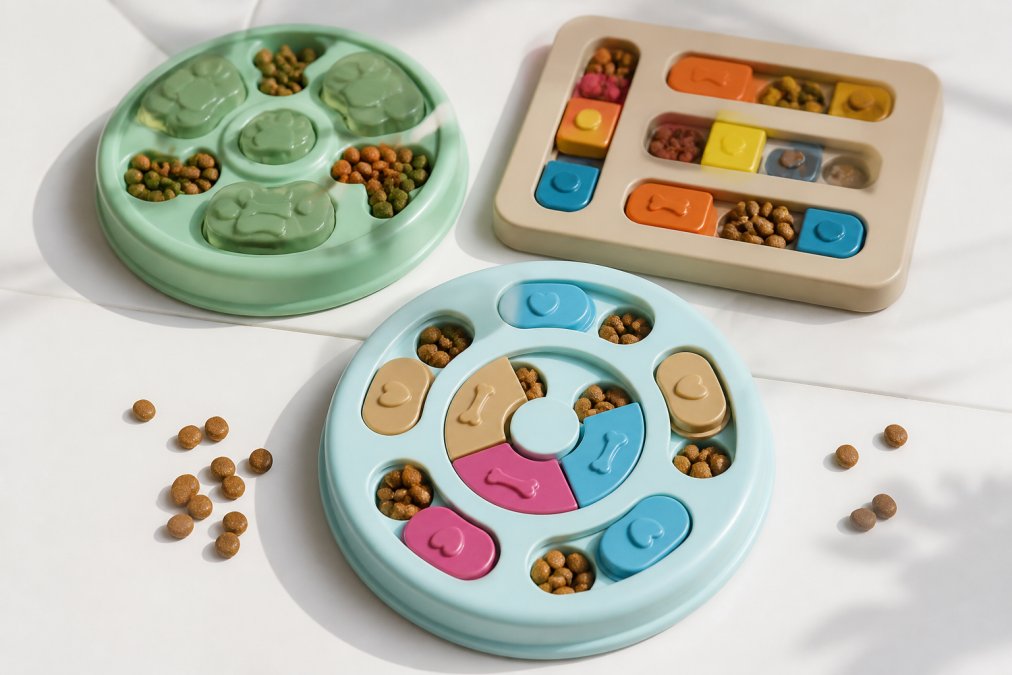
At $10.39, this toy delivers exceptional value for cognitive enrichment. It accommodates small, medium, and large dogs, growing with your puppy through different life stages.
The primary limitation is durability with aggressive chewers. This toy is designed for problem-solving, not heavy chewing. Supervision remains essential.
Roll & Reward Interactive Feeder Toy: Best for Active Play
The Roll & Reward's wobbling design moves unpredictably, triggering natural chasing and pouncing instincts while dispensing treats. Puppies get physical exercise combined with cognitive engagement. For high-energy puppies or those showing early destructive behavior, this toy provides an outlet satisfying multiple needs.
At $15.90, it justifies the cost through versatility. The toy works for both dogs and cats. Treats release gradually as the toy moves, extending playtime and supporting healthy eating habits.
The wobbling design creates noise on hard floors. For apartments or noise-sensitive households, this matters. Test this toy in your specific environment before committing to regular use.
Planet Treat Ball: Best for Bouncy Enrichment
The Planet Treat Ball offers unpredictable bouncing combined with treat dispensing. Made from Orbee-Tuff material engineered for durability, it's safe for puppy teeth. The unpredictable bounce keeps puppies engaged in active chase, burning energy while earning rewards.
At $13.41, this option sits between the other toys in price. The mint scent adds sensory engagement that many puppies find appealing. The small size suits puppies and smaller breeds, though larger puppies may outgrow it quickly.
The bouncy nature means this toy can roll under furniture. Puppies may become frustrated if the ball bounces away during play.
How to Choose the Right Puzzle Feeder for Your Puppy
Match the toy to your puppy's play style and developmental stage. Chase-driven puppies excel with the Planet Treat Ball, while manipulators respond better to the Interactive Treat Puzzle Toy. The Roll & Reward bridges both styles.

Age-specific progression matters: puppies under 12 weeks need simpler designs with immediate reward feedback. By 16 weeks, most handle slightly more complex designs. By 6 months, puppies tackle more challenging variations.
Consider eating speed and digestive sensitivity. Any puzzle feeder slows consumption, beneficial for digestive health. The Roll & Reward's graduated dispensing specifically addresses rapid eating.
Behavioral needs guide selection too. Destructive chewing benefits from active engagement of the Planet Treat Ball or Roll & Reward. Separation anxiety benefits from the cognitive focus of the Interactive Treat Puzzle Toy.
Material preferences matter. Some puppies have sensitivities to rubber or plastic. The Planet Treat Ball's Orbee-Tuff material is BPA-, lead-, and phthalate-free, addressing common sensitivities (cpsc.gov).
Space and noise considerations affect practical usability. Apartments should consider the Roll & Reward's noise. Limited play space may find the bouncy Planet Treat Ball challenging. The Interactive Treat Puzzle Toy operates quietly and stays stationary, suiting any living situation.
Cleaning, Safety, and Maintenance for Long-Term Use
Hand-wash puzzle feeders immediately after use. Use warm water and a soft brush to reach crevices. For stubborn residue, soak in warm water for 15 minutes. Allow complete air-drying before refilling to prevent mold growth.
Inspect toys weekly for damage. Look for cracks, loose pieces, or sharp edges. Even minor damage warrants replacement. Puppies' teeth and jaws strengthen rapidly, and minor damage can become dangerous quickly.
Use appropriately-sized treats that fit puzzle openings without forcing. Low-moisture treats work better than fresh foods, which create residue and spoilage. Store toys in cool, dry locations away from direct sunlight.
Replace toys when damage appears or when your puppy outgrows them. Continuing to use undersized toys creates choking hazards.
Choosing the right puzzle feeder transforms your puppy's development in ways standard feeding cannot match. The Interactive Treat Puzzle Toy, Roll & Reward Interactive Feeder Toy, and Planet Treat Ball each address different enrichment needs while supporting cognitive development, healthy eating habits, and behavioral well-being. Start with your puppy's individual play style and developmental stage, introduce toys under supervision, and maintain them properly for long-term safety. The investment in quality puzzle feeders pays dividends in a more confident, engaged, and behaviorally balanced dog. Get started with The Pet Grove's curated puzzle feeder selection and discover how mental stimulation transforms mealtime into your puppy's favorite developmental activity. Free shipping on all orders makes building your enrichment toolkit accessible and convenient.
Frequently Asked Questions
Q: Are puzzle feeders good for puppies?
A: Yes, puzzle feeders are excellent for puppies. They provide mental stimulation that supports cognitive development, slow down eating to aid digestive health, and reduce boredom-related destructive behavior. Interactive feeders turn mealtime into problem-solving play, which builds confidence and keeps puppies engaged. Start with age-appropriate difficulty levels and supervise play, especially with puppies under 12 weeks old.
Q: At what age can a puppy start using a puzzle feeder?
A: Puppies can begin using simple puzzle feeders around 8-12 weeks old, starting with basic designs that require minimal effort. Choose toys with larger openings and fewer moving parts for younger puppies. As your puppy grows and develops better motor skills and problem-solving abilities, gradually introduce more challenging puzzle feeders. Always supervise playtime and ensure treats fit safely through the openings.
Q: How do benefits of interactive dog feeders compare to regular bowls?
A: Interactive dog feeders offer significant advantages over standard bowls. They encourage slower eating, which improves digestive health and reduces bloat risk. They provide mental stimulation and foraging behavior engagement that regular bowls don't offer. Interactive feeders also combat boredom and separation anxiety by making meals more engaging. Puppies using interactive feeders develop better problem-solving skills and behavioral health compared to those eating from flat bowls.
Q: What should I look for when choosing the best slow feeder bowls for puppies?
A: When selecting slow feeders or puzzle feeders for puppies, consider the size and breed of your dog, the difficulty level appropriate for their age, material durability and non-toxicity (BPA-free), and ease of cleaning. Look for dishwasher-safe options or those with simple designs. Ensure openings are appropriately sized for your puppy's mouth and treat size. Check for anti-slip bases to prevent sliding during play, and verify supervision requirements based on your puppy's chewing habits.
This article was written using GrandRanker


