

Benefits of Grain Free Cat Food: A 2026 Vet-Informed Guide
Table of Contents
- What Grain-Free Cat Food Actually Is (and Isn't)
- Grain-Free vs Grain-Inclusive Cat Food: What the Label Doesn't Tell You
- Signs of Food Allergies in Cats That Point to a Diet Change
- The Real Benefits of Grain-Free Cat Food for Adult Cats
- How to Transition Cat Food Safely Without Digestive Upset
- How to Read a Grain-Free Label Like a Vet
- When Grain-Free Isn't the Answer: Life Stages and Health Conditions
- Frequently Asked Questions
Last Updated: September 11, 2026
What Grain-Free Cat Food Actually Is (and Isn't)
Grain free cat food removes grains such as corn, wheat, rice, and barley, replacing them with peas, potatoes, or tapioca. True grain-free recipes are not automatically low-carbohydrate, and that distinction matters more than the label suggests.

The benefits of grain free cat food get oversold. Cats are obligate carnivores, but that doesn't make every grain a villain: a food can be grain-free and still loaded with carbohydrate-rich fillers, or contain rice and still deliver excellent feline nutrition. The label tells you what's absent, not what's inside.
This guide breaks down what grain-free formulas genuinely offer, when they help, and when they're just a pricier bag of the same thing.
Grain-Free vs Grain-Inclusive Cat Food: What the Label Doesn't Tell You
The grain-free versus grain-inclusive debate centers on carbohydrate sources, not quantity. Many grain-free kibbles swap corn for peas or potatoes, ending up with a nearly identical carbohydrate percentage.
American Association of Feed Control Officials pet food labeling standards sets the rules manufacturers follow, and those rules allow a "grain-free" claim even when the food contains high-glycemic alternatives.
What to compare instead of the grain-free badge:
- Protein-to-fat ratio on the guaranteed analysis panel
- First three ingredients (should be named animal proteins)
- Carbohydrate content calculated by subtracting protein, fat, fiber, moisture, and ash from 100
- Taurine level, an essential amino acid cats cannot synthesize in sufficient quantities
Digestibility separates a good formula from a cheap one. A food packed with pea protein may list high protein on paper while offering lower bioavailability than a chicken-based recipe.
Signs of Food Allergies in Cats That Point to a Diet Change
Signs of food allergies in cats typically appear as skin irritation, excessive grooming, hair loss, and gastrointestinal upset rather than dramatic reactions.
Watch for these clinical symptoms:
- Itchy skin, especially around the head and neck
- Vomiting or chronic diarrhea
- Bald patches from over-grooming
- Recurring ear infections
- Red, inflamed skin
Here's the part most owners get wrong: true food allergies in cats are relatively uncommon, and the culprit is usually a protein, not a grain. Chicken, beef, and fish trigger most reactions. A grain-free food containing chicken won't help a cat allergic to chicken. That's why veterinary guidance on elimination diets from Cornell University's College of Veterinary Medicine recommends a structured elimination diet rather than guessing.
If symptoms persist, an elimination diet using a novel protein or hydrolyzed formula is the standard diagnostic approach, run over several weeks before drawing conclusions.
The Real Benefits of Grain-Free Cat Food for Adult Cats
The genuine benefits of grain-free cat food appear when the formula prioritizes animal protein and your cat has a specific sensitivity to grains. For most healthy adult cats, the benefit comes from overall recipe quality, not the absence of grain.
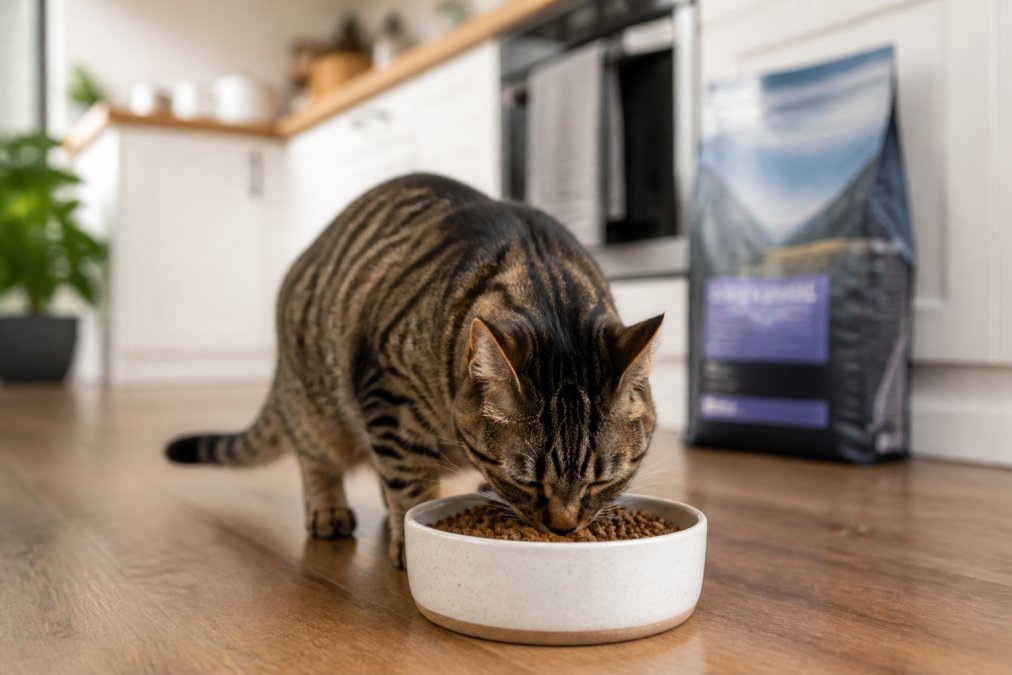
What Grain-Free Actually Changes in the Bowl
Removing grains changes the carbohydrate source, not necessarily the load. A grain-inclusive kibble might use corn and rice; a grain-free version swaps in peas, lentils, chickpeas, or potatoes, and the guaranteed analysis can end up nearly identical.
Where grain-free formulas earn their place:

- Higher protein density supports lean muscle maintenance and energy metabolism in adult cats. A recipe with 40% protein versus 30% gives your cat more of the macronutrient its obligate-carnivore physiology is built to use.
- Fewer fillers can mean better digestibility for sensitive cats. When a formula replaces corn gluten meal with named animal proteins, the amino acid profile becomes more bioavailable.
- Limited ingredient options simplify troubleshooting dietary sensitivity. Fewer ingredients means fewer variables when you're trying to isolate a trigger.
- Animal-focused recipes align with feline macronutrient needs. Cats lack the metabolic pathways to efficiently use carbohydrates, so a recipe that leans on animal tissue matches their biology more closely.
The Mechanism: Why Protein Quality Beats Grain Absence
Cats are obligate carnivores with a limited ability to downregulate gluconeogenesis, meaning they continuously convert protein to glucose for energy (peer-reviewed research). Highly digestible animal protein supports that process efficiently, while plant proteins like pea protein isolate may show high protein on the guaranteed analysis but deliver lower bioavailability.
That gap shows up in your cat's coat, energy, and litter box: a cat eating a high-quality animal-protein recipe often has a softer coat, more consistent energy, and smaller, less odorous stools.
What the Research and Veterinary Consensus Actually Say
Most veterinary nutritionists agree that grains are not inherently bad for cats. The concern with grain-free diets is twofold: they can cost more without delivering measurable benefit for a healthy cat, and some swap grains for ingredients that are harder to digest.
The FDA investigated a potential link between grain-free diets and canine dilated cardiomyopathy (DCM) in dogs, prompting broader scrutiny of grain-free formulations across species. For cats, the concern is less about DCM and more about meeting AAFCO nutrient profiles with high-quality protein sources.
When Grain-Free Delivers Real Value
Grain-free food is genuinely beneficial in specific scenarios:
- Confirmed grain allergy or sensitivity. True grain allergies are rare in cats, but they exist. If an elimination diet confirms a reaction to a specific grain, a grain-free formula removes that trigger.
- Sensitive digestion. Some cats show improved stool quality and less vomiting on a grain-free, high-protein diet, likely because the carbohydrate fraction is more digestible.
- Owner preference for animal-focused nutrition. If you want to feed a diet that mirrors a cat's natural prey composition, grain-free recipes often come closer to that ideal.
What to Look For Instead of the Grain-Free Badge
Rather than relying on the grain-free claim, evaluate the formula on these criteria:
- First three ingredients should be named animal proteins (e.g., chicken, turkey, salmon).
- Protein-to-fat ratio on the guaranteed analysis panel should align with your cat's life stage and activity level.
- Carbohydrate content calculated by subtracting protein, fat, fiber, moisture, and ash from 100. Many grain-free kibbles still run 30% or more carbohydrates.
- Taurine level must be adequate; taurine is an essential amino acid cats cannot synthesize in sufficient quantities.
- AAFCO nutritional adequacy statement confirming the food meets profiles for your cat's life stage.
A Note on Product Examples
When evaluating specific brands, look past the grain-free label. A high-protein grain-free recipe with real chicken first and no chicken by-product meals, corn, wheat, or soy can suit cats who do well on animal-focused nutrition, and a recipe coating kibble in freeze-dried raw ingredients may boost palatability while staying grain-free. The principle is the same: protein first, fillers last, and the grain-free claim secondary to overall recipe quality.
How to Transition Cat Food Safely Without Digestive Upset
Transitioning cat food safely takes seven to ten days of gradual mixing, not an overnight switch. Abrupt changes commonly trigger vomiting or diarrhea.
Follow this protocol:
| Day | Old Food | New Food |
|---|---|---|
| 1-2 | 75% | 25% |
| 3-4 | 50% | 50% |
| 5-6 | 25% | 75% |
| 7-10 | 0% | 100% |
Slow down if you see loose stools or vomiting. Some cats need two to three weeks. A common mistake is rushing because your cat loves the new food's taste, then dealing with digestive fallout for days.
How to Read a Grain-Free Label Like a Vet
Reading a grain-free label means checking the guaranteed analysis, the ingredient split, and the AAFCO nutritional adequacy statement, in that order. The front of the bag is marketing. The back is where the facts live.
Start with the nutritional adequacy statement. It should confirm the food meets AAFCO profiles for your cat's life stage. Then scan ingredients for named animal proteins in the first three slots. Finally, calculate carbohydrate content yourself; many grain-free foods still run high in carbs once you do the math.
Red flags to watch for:
- Vague terms like "meat meal" without a named animal
- Multiple carbohydrate sources listed separately to push each lower on the panel
- No taurine listed or added
- Missing life-stage statement
When Grain-Free Isn't the Answer: Life Stages and Health Conditions
Grain-free isn't the answer for every cat, and life stage changes the calculus. Kittens need specific nutrient ratios for growth that some grain-free formulas don't meet, and senior cats with kidney or thyroid conditions need veterinary-guided diets that may include grains for good reason.
Kittens: Growth Demands Precision, Not Marketing
Kittens are not small adult cats. They need higher protein, fat, calcium, phosphorus, and amino acids like arginine and taurine for rapid growth. A grain-free formula meeting AAFCO's growth profile can be appropriate, but many grain-free recipes are formulated for adult maintenance only.

What to check for a kitten:
- AAFCO statement must specify "growth" or "all life stages," not "adult maintenance."
- Protein content should be at least 30% on a dry matter basis, often higher for growing kittens.
- Calcium-to-phosphorus ratio should be approximately 1.1:1 to 1.3:1 for proper bone development.
- Taurine must be adequate; deficiency can cause blindness and heart disease in growing cats.
A common mistake is feeding a grain-free adult formula to a kitten because the owner assumes grain-free is inherently better. If it doesn't meet growth requirements, the kitten may develop nutritional deficiencies even while eating a "premium" food.
Adult Cats: Maintenance and Individual Variation
For healthy adult cats, the primary consideration is maintaining lean muscle mass and ideal body condition. A grain-free diet can work well if it delivers high-quality animal protein and appropriate fat levels, but adult cats vary widely in activity level, metabolism, and body condition, so the protein-to-fat ratio that suits one may be wrong for another.
Key considerations for adults:
- Protein-to-fat ratio should match activity level. Active cats do well with higher protein and moderate fat; sedentary cats may need lower fat to prevent weight gain.
- Carbohydrate content matters for cats with diabetes or insulin resistance. Some grain-free foods are still high in carbohydrates from peas or potatoes.
- Palatability can shift with age; a food your cat loved at three may sit untouched at twelve.
Senior Cats: Health Conditions Change the Rules
Senior cats often have health conditions that make grain-free diets inappropriate without veterinary guidance. Chronic kidney disease, hyperthyroidism, diabetes, and inflammatory bowel disease all require specific nutritional management.
- Chronic kidney disease (CKD): Cats with CKD often need restricted phosphorus and moderated protein levels. A high-protein grain-free diet may be contraindicated. Veterinary-prescribed renal diets often contain grains like rice or corn as easily digestible carbohydrate sources.
- Hyperthyroidism: This condition increases metabolism and can cause weight loss. Senior cats with hyperthyroidism may need higher calorie density and careful monitoring of protein and phosphorus.
- Diabetes mellitus: Carbohydrate content is critical. Some grain-free foods are lower in carbs, but not all. A veterinary-guided diet is essential for glycemic control.
- Inflammatory bowel disease (IBD): Some cats with IBD do better on limited-ingredient or hydrolyzed diets, which may or may not be grain-free. The trigger is often a protein, not a grain.
The Unique Angle: A Life-Stage Decision Framework
Instead of asking "Is grain-free good for cats?" ask these questions in order:
- What life stage is my cat in? Kitten, adult, or senior.
- Does my cat have any diagnosed health conditions? If yes, veterinary guidance overrides general recommendations.
- Has my cat shown signs of food sensitivity? If yes, an elimination diet is the next step, not a blind switch to grain-free.
- Does the grain-free formula meet AAFCO nutrient profiles for my cat's life stage? If not, it's not appropriate regardless of the grain-free label.
- Is the formula high in animal protein and low in carbohydrate fillers? If yes, it may be a good choice. If no, the grain-free label is meaningless.
When Grains Are Actually the Better Choice
Grains are sometimes not just acceptable but preferable:
- Cats with CKD may benefit from the moderated protein and phosphorus levels in veterinary renal diets, which often include rice or corn.
- Cats with certain gastrointestinal conditions may digest cooked grains more easily than high-fiber legume-based grain-free formulas.
- Cats with food allergies to common proteins may do well on a limited-ingredient diet with a novel carbohydrate source like oat or barley.
- Budget-conscious owners can often find grain-inclusive diets that meet the same nutritional standards at a lower cost.
The honest position: grain-free is a tool, not a universal upgrade. Match the diet to the individual cat, and let your vet weigh in when health conditions are in play.
Frequently Asked Questions
Is grain-free actually better for cats?
It depends on the cat. Grain-free formulas often contain higher protein and fewer fillers, which aligns with a cat's obligate carnivore biology. But grain-free is not automatically healthier. For cats with diagnosed food allergies or dietary sensitivity to grains, a grain-free diet can reduce skin irritation and gastrointestinal symptoms. For healthy cats without sensitivities, grain-inclusive diets with quality animal protein work just as well. The key is the overall nutrient density, not just the absence of grain.
Why do some vets not recommend grain-free cat food?
Some veterinarians caution against grain-free diets because grains are rarely the actual allergen in cats. Most feline food allergies trace back to animal proteins like chicken or fish, not wheat or corn. Vets also worry that pet owners may choose grain-free for marketing reasons rather than medical need. However, grain-free food still has a place when a cat has a confirmed grain sensitivity or when the formula delivers higher protein, better digestibility, and limited fillers.
How can I tell if my cat has a grain allergy?
Watch for signs of food allergies in cats such as itchy skin, excessive grooming, hair loss, ear infections, vomiting, or diarrhea. These clinical symptoms can also point to food intolerance rather than a true allergy. A veterinary consultation and an elimination diet are the only reliable ways to confirm whether grains trigger your cat's reactions. If symptoms improve on a grain-free or limited ingredient diet and return when the old food is reintroduced, that pattern suggests a dietary sensitivity worth discussing with your vet.
How long should I transition my cat to grain-free food?
A safe transition takes 7 to 10 days. Start by mixing 25% new food with 75% old food for three days. Move to a 50/50 ratio for the next three days, then 75% new food for another three days. Finish with 100% grain-free food. Cats have sensitive digestive systems, so rushing the process can cause vomiting or diarrhea. If your cat refuses the new food or shows gastrointestinal upset, slow down and extend each phase.
Choosing the right food for a cat with dietary sensitivity or a grain-related concern takes more than grabbing the bag with the green label. The Pet Grove curates grain-free and limited ingredient options like Blue Buffalo Wilderness, Instinct Original, and Tiki Cat Born Carnivore, all backed by free shipping and a selection built around genuine feline nutrition. Get started with The Pet Grove and give your cat a diet chosen with care, not marketing.


