

Benefits of Interactive Puzzle Feeders
Table of Contents
- What Interactive Puzzle Feeders Do
- Mental Stimulation and Cognitive Enrichment
- Slowing Down Mealtime and Supporting Digestive Health
- Best Puzzle Feeders for Fast Eaters
- Reducing Anxiety and Preventing Destructive Behavior
- How to Introduce Puzzle Feeders to Dogs
- Mental Stimulation for Senior Dogs
- Troubleshooting Common Frustrations
Last Updated: August 30, 2026
What Interactive Puzzle Feeders Do
Interactive puzzle feeders are toys designed to dispense food or treats as your dog or cat solves the puzzle, turning mealtime into an engaging mental challenge. Instead of eating from a bowl, your pet must manipulate pieces, roll the toy, or work through compartments to access their food. This taps into your pet's natural foraging instincts, the same behaviors they'd use in the wild to hunt and scavenge.
The Pet Grove carries several puzzle feeder options, including the Interactive Treat Puzzle Toy, which encourages problem-solving through treat discovery, and the Roll & Reward Interactive Feeder Toy, a wobbling design that dispenses treats as your pet plays.


Mental Stimulation and Cognitive Enrichment
A dog's brain needs regular activation, and feeding time is one of the easiest windows to provide it. Mental stimulation through puzzle feeders strengthens cognitive function, builds problem-solving pathways, and keeps older dogs sharper longer. Dogs that lack mental enrichment often develop behavioral problems because their brains aren't being used.
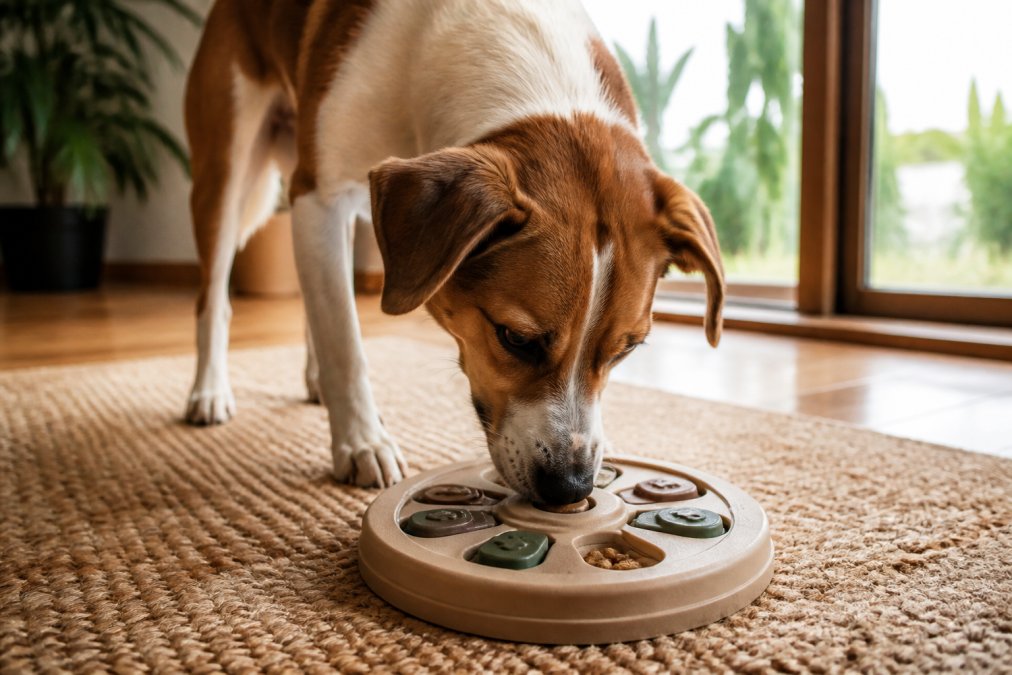
Research consistently shows that environmental enrichment improves behavioral outcomes in dogs. When you introduce puzzle feeders, you're providing what behaviorists call "cognitive enrichment", activities that require problem-solving and decision-making. This is especially valuable for intelligent breeds like Border Collies, Poodles, and German Shepherds that were bred to work and think independently.
Your dog's brain releases dopamine when they solve the puzzle and access the reward. Over time, this creates positive neural associations with mental effort. Dogs begin to seek out problem-solving opportunities, which translates to better behavior overall. A mentally stimulated dog is calmer, more focused, and less likely to develop destructive habits.
For senior dogs, puzzle feeders become even more valuable. Research on canine cognition shows that mental engagement slows cognitive decline.
Slowing Down Mealtime and Supporting Digestive Health
Fast eating creates real health risks. When dogs gulp their food, they swallow air along with kibble, which can lead to bloat or gastric dilatation-volvulus (GDV), a serious, sometimes fatal condition. Slowing down mealtime directly reduces that risk.
Puzzle feeders force your dog to eat in smaller portions, separated by the time it takes to manipulate the toy. Instead of finishing a bowl in 30 seconds, mealtime extends to 10-15 minutes. This gives your dog's digestive system time to signal fullness to the brain, reducing overall intake and improving digestion.
When food moves through the digestive tract more slowly, your dog's body has more time to extract nutrients. Dogs that use puzzle feeders often show improved stool quality and fewer digestive complaints. For dogs prone to gulping, the Roll & Reward Interactive Feeder Toy is particularly effective because the wobbling motion makes it impossible to eat quickly.
Dogs that eat slowly are also less likely to exhibit food-guarding behaviors or resource aggression. When eating becomes a process rather than a race, the anxiety around food naturally decreases. This is especially valuable in multi-dog households.
Best Puzzle Feeders for Fast Eaters
Fast eaters need puzzle feeders that force them to slow down through design. The most effective options physically prevent rapid consumption.
The Roll & Reward Interactive Feeder Toy works exceptionally well because its wobbling motion means your dog can't simply put their mouth over an opening and gulp. The toy rolls unpredictably, forcing your dog to chase it, push it, and work for each piece.
For dogs that need more challenge, the Interactive Treat Puzzle Toy combines difficulty with slow-feeding benefits. The moveable pieces require manipulation before treats release, so your dog must think and move rather than simply eat.
The Planet Treat Ball offers a different approach: it's a bouncy ball with treat openings that dispense as your dog rolls and chases it. This encourages physical activity alongside mealtime enrichment.

When choosing for a fast eater, prioritize design features that prevent direct access to food. Avoid flat dishes or simple designs with large openings. Look for toys that require your dog to work around obstacles, push pieces aside, or chase a moving object.
Reducing Anxiety and Preventing Destructive Behavior
Destructive behavior in dogs often stems from anxiety or boredom. When dogs lack appropriate outlets for their energy and mental drive, they redirect that energy toward destructive activities: chewing furniture, shredding cushions, or digging. Puzzle feeders address this by providing structured engagement during times when anxiety is highest.
Many destructive behaviors peak during feeding times or when dogs are left alone. Puzzle feeders solve both problems simultaneously. They occupy your dog's attention, redirect their focus toward a rewarding activity, and create positive associations with the time of day that previously triggered anxiety.
The puzzle itself provides a calming focus, your dog's brain is occupied with solving a problem rather than spiraling into anxious thoughts. The reward reinforces calm, focused behavior. The routine of using the puzzle feeder at the same times each day creates predictability, which reduces overall anxiety.
For anxious dogs, consistency is key: use the puzzle feeder at the same times daily, and pair it with the situations that trigger anxiety.
How to Introduce Puzzle Feeders to Dogs
Introduction matters. A dog that's never seen a puzzle feeder might ignore it, get frustrated, or try to destroy it if you simply swap their bowl for a puzzle toy. Proper introduction takes patience and builds success gradually.
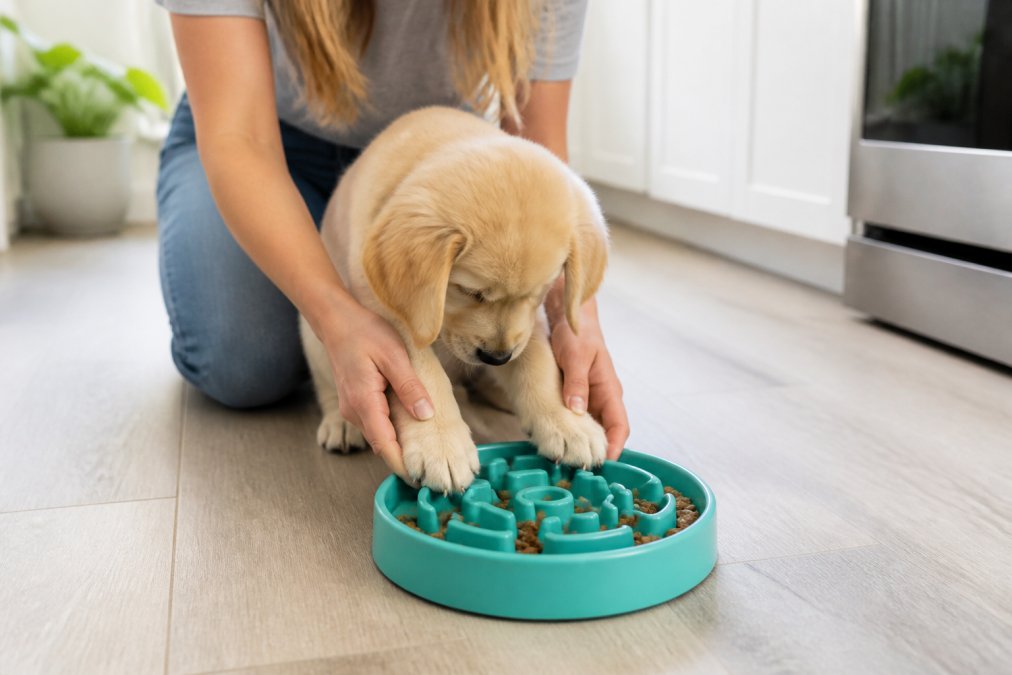
Start with the puzzle feeder completely empty and open. Let your dog investigate the toy without any pressure. Once your dog shows interest, place a few treats inside with it still fully accessible. Don't hide anything yet. Your goal is to create a positive association: puzzle feeder equals good things.
After 2-3 sessions of easy access, start closing or partially covering one compartment. Make it obvious where the treats are and easy to access. Your dog should succeed on the first or second try. Success builds confidence and motivation.
Gradually increase difficulty over 1-2 weeks. Move from fully accessible to slightly hidden, then moderately hidden, then challenging. This progression prevents frustration while building your dog's problem-solving skills.
Watch your dog's body language during introduction. Excitement and gentle pawing mean you're on the right track. Whining, intense scratching, or attempts to destroy the toy mean the puzzle is too difficult. Back up to an easier level and progress more slowly.
For dogs that seem uninterested initially, try using higher-value treats, introduce the puzzle during times when your dog is hungry, or use a puzzle feeder that requires less manipulation, like the Roll & Reward Interactive Feeder Toy.
Never rush the introduction process. Patience during this phase determines whether the puzzle feeder becomes a beloved enrichment tool or an abandoned toy.
Mental Stimulation for Senior Dogs
Senior dogs often experience cognitive decline, but research shows that mental engagement slows this decline significantly. Puzzle feeders become more valuable as dogs age.
Cognitive decline in senior dogs manifests as confusion, disorientation, difficulty learning new behaviors, or loss of interest in activities they once enjoyed. These changes are symptoms of canine cognitive dysfunction. Mental stimulation doesn't reverse aging, but it demonstrably slows cognitive deterioration.
For senior dogs, choose puzzle feeders that don't require intense physical effort but still demand mental engagement. The Interactive Treat Puzzle Toy works well because it requires moderate manipulation without high-impact movement.
Senior dogs also benefit from variety. Rotating between different puzzle feeders prevents habituation, where your dog learns the solution so completely that it provides no mental challenge. Use one puzzle feeder for a week, then switch to another.
Feeding time becomes one of the most valuable windows for cognitive engagement in a senior dog's day. A 15-minute puzzle feeder session engages your dog's brain in ways that a bowl never will.
Troubleshooting Common Frustrations
Not every puzzle feeder works for every dog, and not every introduction goes smoothly. Common frustrations have straightforward fixes.
Dog ignores the puzzle feeder: This usually means the puzzle is too difficult, the treats aren't appealing enough, or your dog hasn't had enough introduction time. Start with a simpler toy or one that requires less manipulation. Use treats your dog loves more than regular kibble. Give it 2-3 weeks before deciding the puzzle feeder isn't a fit.
Dog tries to destroy the toy: Some dogs approach puzzles aggressively rather than thoughtfully. This signals either frustration or an extremely high prey drive. Never leave a destructible puzzle feeder unsupervised with a dog that shows this behavior. Choose durable, non-destructible options like the Tough Rubber Chew Toy for Dogs.
Dog gets frustrated and gives up: This is the clearest sign the puzzle is too difficult. Revert to a simpler version. Success builds motivation; frustration kills it.
Puzzle feeder causes choking or intestinal blockage: This happens when dogs destroy the toy and ingest pieces. Prevention is supervision. Remove the puzzle feeder if your dog shows destructive tendencies.
Dog solves puzzle too quickly and loses interest: Your dog has outgrown that puzzle's difficulty. Rotate to a more challenging option, or use multiple puzzles in rotation to maintain novelty. The Interactive Treat Puzzle Toy allows you to adjust difficulty by changing how tightly pieces fit.
Puzzle feeder is difficult to clean: Most puzzle feeders have crevices where food particles accumulate. Soak in warm water for 10-15 minutes before washing, then use a bottle brush or pipe cleaner to reach narrow spaces. Some feeders are dishwasher safe, check the manufacturer's specifications.
Interactive puzzle feeders transform feeding from a passive activity into mental work that keeps your dog's brain sharp, reduces anxiety, and prevents destructive behavior. At The Pet Grove, we understand that pet enrichment isn't optional, it's essential to your dog's health and happiness. Our carefully selected puzzle feeders are designed to challenge your pet's mind while supporting their digestive health and emotional wellbeing. Start with the right puzzle feeder for your dog's skill level, and watch how mealtime becomes the highlight of their day. Get started with The Pet Grove's interactive puzzle feeders and give your dog the mental engagement they deserve.
| Benefit | How Puzzle Feeders Help | When to Use |
|---|---|---|
| Mental stimulation | Requires problem-solving during feeding | Every meal or daily snack time |
| Slowing eating | Forces smaller portions over longer time | For dogs that gulp or eat too fast |
| Anxiety reduction | Provides calming focus and routine | During departure times or high-stress periods |
| Digestive health | Extends mealtime and improves nutrient absorption | At regular feeding times |
| Preventing destructive behavior | Redirects energy toward positive activity | When dog is alone or anxious |
| Cognitive health in senior dogs | Maintains mental sharpness through engagement | Daily for aging dogs |
According to the American Kennel Club's guide to canine enrichment, mental stimulation is as important as physical exercise for dogs' overall wellbeing. Research from veterinary behaviorists at UC Davis on canine cognition demonstrates that dogs using puzzle feeders show measurable improvements in problem-solving ability and reduced anxiety behaviors compared to dogs fed from bowls. A study on gastric health in dogs by the Journal of the American Veterinary Medical Association found that slow-feeding methods significantly reduce the risk of bloat and GDV in at-risk breeds.
Frequently Asked Questions
What are the main benefits of interactive puzzle feeders?
Interactive puzzle feeders provide mental stimulation, slow down eating to aid digestion, reduce anxiety, and prevent destructive behavior. They engage your pet's natural foraging instinct, turning meals into problem-solving activities. For fast eaters, they're especially valuable in preventing bloat and GDV risk.
How do I introduce puzzle feeders to dogs who've never used one?
Start with an easy-difficulty feeder and place it on the floor with treats already partially visible. Let your dog explore at their own pace without pressure. Reward curiosity with praise. Gradually reduce treat visibility as they understand the concept. Keep initial sessions short, around 5-10 minutes. Use high-value treats to maintain interest and build positive associations with the toy.
Are puzzle feeders suitable for senior dogs and cats?
Yes, puzzle feeders are excellent for senior pets. Mental stimulation slows cognitive decline and keeps aging brains active. Choose feeders with lower difficulty levels that don't require excessive jumping or aggressive pawing. Senior dogs benefit from gentler options like the Roll & Reward Interactive Feeder Toy, which wobbles slowly and doesn't demand intense physical effort. Cats of any age enjoy puzzle feeders designed for feline foraging, as they appeal to natural hunting behaviors.
Can I use wet food in puzzle feeders?
Most interactive puzzle feeders work best with dry kibble or small treats. Wet food can stick to internal mechanisms and create hygiene issues. If your pet requires wet food, look for puzzle feeders with large, simple openings designed for moisture, or use them exclusively with dry options. Always check the product specifications before attempting wet food, and clean thoroughly after use to prevent mold or bacterial growth.
This article was written using GrandRanker


